Summary
On 13 July the FCA made the biggest change to UK short selling disclosure in fourteen years. The old public register — the one that told you which hedge funds were short which companies, by name — is gone. In its place the FCA now publishes a single anonymised number per company. I ingest these files every day for the short interest data shown on the company pages on this site. The format changed and I had to make changes. And because the old and new data overlap for a few days, we can do something that won't be possible again: compare them, and see exactly how much short interest the old register was hiding. Short answer — it's about a third.
How the old system worked
For those coming to this fresh: since 2012, any fund whose net short position in a UK-listed company crossed 0.2% of the company's issued share capital had to privately notify the FCA (that threshold was temporarily cut to 0.1% during COVID — more on that later). Only positions of 0.5% or more were made public, and those came with the fund's name attached. That's the spreadsheet many of us have watched daily for years — e.g. "Marshall Wace, 1.2% short of Ocado".
To be fair to the old register, it captured a lot. The positions were net (short minus long) and delta-adjusted, which means shorts built through CFDs, options, futures and even index exposure all counted towards the number, not just straightforward stock borrowing.
But it had some real blind spots:
- Everything between 0.2% and 0.5% was invisible. The FCA knew about it. But we didn't. If five funds each sat at 0.45%, the public register showed zero short interest.
- Funds gamed the threshold. Academic studies of the European regime found clear clustering of positions just under 0.5% — funds deliberately capping positions to stay off the public list. So the register didn't just undercount, it undercounted in a biased way.
- Netting hides gross activity. A fund short 2% through stock but long 1.8% through call options showed a net 0.2% — nothing public at all.
- Market makers were exempt, and intraday shorts never appeared because positions were snapshotted at midnight.
The new system
From 13 July the FCA publishes what it calls the ANSP (Aggregate Net Short Position) for each company — the sum of every notified position at or above 0.2%, published each working day at noon, two working days in arrears, with no names.
What we gained is a more honest total, because the 0.2–0.5% positions that were previously invisible are now in the number. What we lost is the "who". A short from a well-known activist fund means something quite different from an anonymous 0.6%, and you can no longer watch a specific fund scale in or out over weeks. You also can't tell whether 10% short interest is one whale or twenty small funds.
Why did they change it? The bit almost nobody knows
The review happened because of Brexit — the old rules were inherited EU law and were up for rewrite anyway. The case for scrapping named disclosure came from fund managers, who told the Treasury three things: naming invites copycat trading and short squeezes, it deters funds from shorting above the threshold at all (true, as we're about to see), and it gives away proprietary research.
Here's the part I found genuinely surprising when I read the Treasury's response document. The consultation received 856 responses — and 831 of them were retail investors, many using what the government called "template responses promoted on social media". An organised campaign, straight out of the post-GameStop retail activism playbook. And they were asking for more transparency — US-style transaction reporting, settlement crackdowns, market maker enforcement. The Treasury was polite about it — "grateful for all the contributions" — but noted the responses "appeared largely to provide feedback on the US model of regulation rather than the UK's regime". None of the US-style measures they asked for made it into the final decisions, and the settlement-discipline ask was parked in a separate future review. The change that did get made was the one the hedge funds asked for.
So the retail campaign lost 831-to-25, and the argument that won was, in effect, "named disclosure lets squeeze campaigns target us". GameStop is never mentioned in the document, but it hangs over every page. The published register had become a target list, and UK forums did use it as a "most shorted = squeeze candidate" screen. Interestingly, the companies themselves argued to keep the naming — they liked knowing who was betting against them. They lost too.
What the first week of data shows
Because the old register was frozen just before the switchover and the new ANSP files started a few days later, we get a one-off natural experiment: for every company, the gap between the two numbers is short interest that was always there but never public.
How misleading were the old numbers? Days before the switchover, a widely reported White & Case analysis found UK short positions at record levels, citing Vistry at 16% and Ibstock at 13%. Those figures were a perfectly correct reading of the public register. The real numbers, revealed a week later: 20.7% and 18.2%.
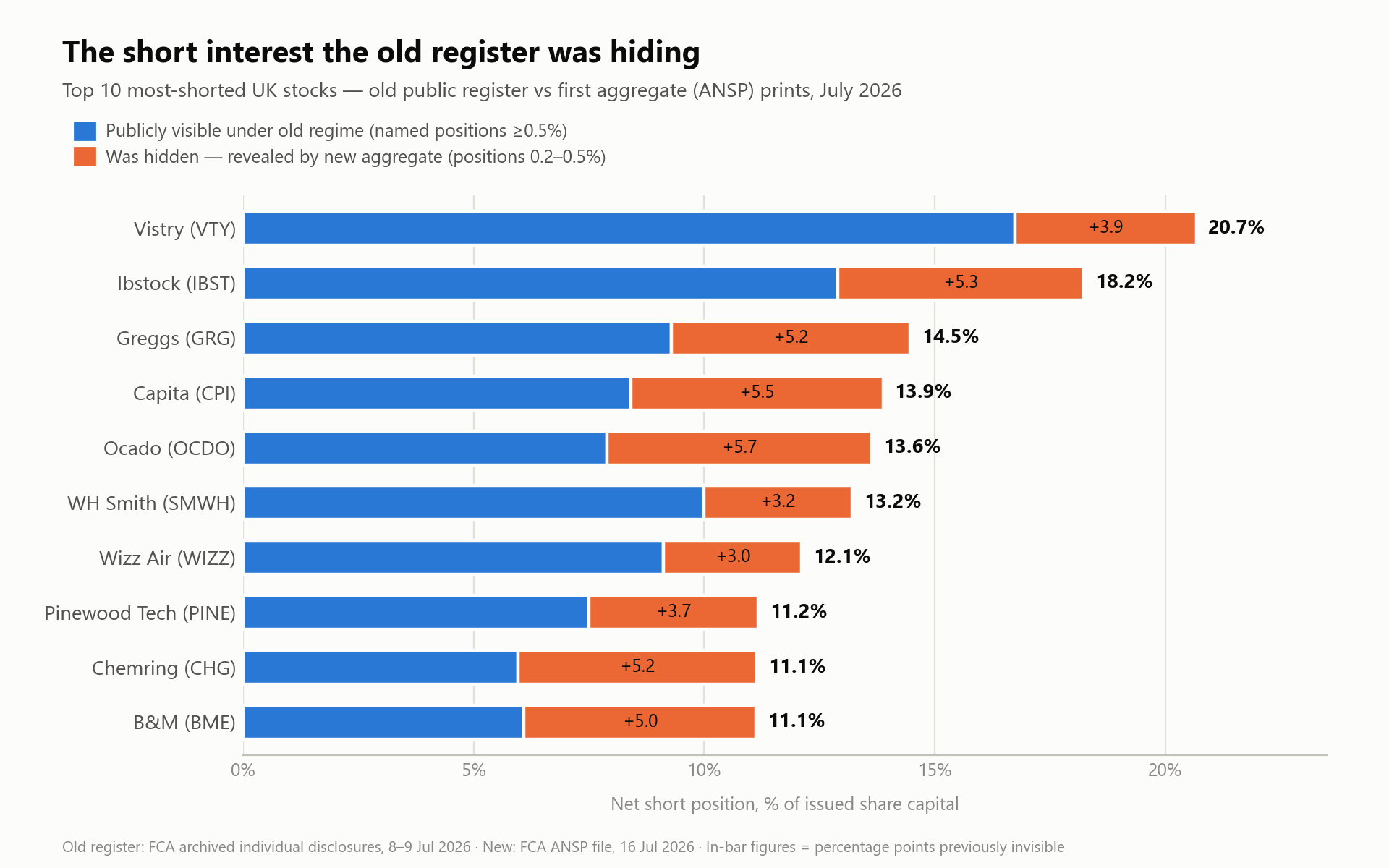
Here is the full top 20 (ANSP as of 16 July, market caps as of 17 July):
| Company | Ticker | Mkt cap | Old public register | New ANSP | Was hidden |
|---|---|---|---|---|---|
| Vistry Group | VTY.L | £894m | 16.7% (18 funds) | 20.7% | +3.9pp |
| Ibstock | IBST.L | £375m | 12.9% (13) | 18.2% | +5.3pp |
| Greggs | GRG.L | £1.62bn | 9.3% (9) | 14.5% | +5.2pp |
| Capita | CPI.L | £280m | 8.4% (10) | 13.9% | +5.5pp |
| Ocado | OCDO.L | £1.41bn | 7.9% (11) | 13.6% | +5.7pp |
| WH Smith | SMWH.L | £615m | 10.0% (11) | 13.2% | +3.2pp |
| Wizz Air | WIZZ.L | £1.14bn | 9.1% (9) | 12.1% | +3.0pp |
| Pinewood Technologies | PINE.L | £340m | 7.5% (9) | 11.2% | +3.7pp |
| Chemring | CHG.L | £1.49bn | 6.0% (6) | 11.1% | +5.2pp |
| B&M | BME.L | £2.00bn | 6.1% (8) | 11.1% | +5.0pp |
| Domino's Pizza | DOM.L | £727m | 7.4% (9) | 11.0% | +3.5pp |
| Metlen Energy & Metals | MTLN.L | €6.3bn | 5.8% (6) | 10.1% | +4.3pp |
| Travis Perkins | TPK.L | £1.19bn | 5.7% (7) | 9.9% | +4.2pp |
| Crest Nicholson | CRST.L | £170m | 8.1% (8) | 9.8% | +1.7pp |
| Genuit | GEN.L | £681m | 5.9% (7) | 9.8% | +3.9pp |
| Breedon | BREE.L | £1.08bn | 6.8% (10) | 9.8% | +3.0pp |
| Kingfisher | KGF.L | £4.94bn | 7.4% (7) | 9.7% | +2.3pp |
| Taylor Wimpey | TW.L | £2.89bn | 6.2% (8) | 9.6% | +3.4pp |
| Smith & Nephew | SN.L | £9.72bn | 7.0% (7) | 9.5% | +2.5pp |
| Yellow Cake | YCA.L | £1.30bn | 5.0% (6) | 9.1% | +4.0pp |
A few things jumped out at me going through this:
Every single name is higher. The average gap is about 4 percentage points on an average short interest of 12% — so roughly a third of the true short interest in these names was invisible under the old rules. Chemring and Ocado are the extreme cases, with nearly half hidden.
More funds were hiding below the line than were ever named. Take Chemring: the old register named 6 funds totalling 6.0%. The new aggregate is 11.1%. That extra 5.2 percentage points is made entirely of positions between 0.2% and 0.5%, which means at least eleven more funds were short and sitting below the naming threshold. The academics who predicted clustering under 0.5% were right, and now we can see the scale of it.
The market's two big UK shorts are housing and the high street. Eight of the top 20 are housebuilding and construction (Vistry, Ibstock, Crest Nicholson, Taylor Wimpey, Breedon, Travis Perkins, Genuit, Kingfisher) and most of the rest are consumer-facing (Greggs, WH Smith, B&M, Domino's, Ocado).
And then there's Vistry. The most-shorted stock in the UK, with a fifth of the company sold short, is up about 20% in seven trading days (234p at the close on 8 July to 282p at the close on 17 July) — and most of that move has come since the regime switched over. The last-ever named register for Vistry read like a hedge fund who's-who: Schonfeld at 2.4%, GLG at 2.2%, Citadel, Point72, Two Sigma, AQR — eighteen funds in all, each one visible, trackable, and updating almost daily. As of last Monday, every one of them vanished behind a single number. Under the old rules we could have watched them one by one and seen who was covering into this rally and who was doubling down. Now a short squeeze and a conviction hold look identical from the outside. The only tell left is whether that 20.7% starts falling in the daily file.
One honest caveat on the comparison: the old register froze around 8–9 July and the first clean ANSP numbers relate to 14 July, so a small part of each gap could be genuine new shorting across those few days. But a systematic 2–6 point jump across all twenty names in under a week isn't real position change — it's the threshold effect being unmasked.
What's still missing
The published number is a floor, never the true figure. The 0.2% threshold applies per fund, not to the total — a fund short 0.19% of Vistry (about 600,000 shares, £1.7m of exposure) reports nothing and adds nothing to the aggregate, and twenty such funds would be roughly 4% of real short interest, entirely invisible. The Chemring arithmetic above suggests the distribution is bottom-heavy: if eleven-plus funds were sitting in the 0.2–0.5% band, the band below 0.2% is probably even more crowded, just in smaller slices. And essentially the whole retail short book — spread bets and CFDs from individuals — is invisible, because no individual position will ever cross 0.2% of a company's share capital.
Here's a detail I haven't seen reported anywhere: the regulator's own visibility shrank last week too. Remember that COVID-era threshold cut — from March 2020 the FCA privately saw every position from 0.1% up, and that stayed in place for six years. The new regime restored the threshold to 0.2%. So on 13 July, not only did the public lose the names; the FCA itself stopped seeing the 0.1–0.2% band it had watched since 2020. When the threshold was cut in 2020, firms complained about a significant increase in the number of reports they had to file — which tells you that band is genuinely populated. All of it just went dark, for everyone, regulator included.
Beyond the thresholds, neither the old system nor the new one captures market maker activity, intraday shorting, or the gross exposure hidden by netting. And this is net directional position data, not stock lending data — those are different (and paid-for) datasets that often tell a different story.
One footnote: the UK has effectively moved towards the US model (aggregated and anonymous) while the EU keeps named disclosure. For dual-listed names you can sometimes still see who's short via the EU registers.
And a practical note if you consume this data yourself: the transition hasn't been flawless. The first ANSP file was published late on day one and the format has its quirks — I found this out the hard way when my ingest pipeline fell over on the morning of the 13th. It's fixed, and the daily ANSP now feeds the short interest shown on each company page on the site, so you can check how crowded the short side of any UK stock is before you buy what looks like a bargain.
What happens next
The rollout isn't quite finished. Phase 2 lands on 30 November 2026, though it's plumbing for the reporting firms rather than for us — bulk CSV submission of position notifications instead of keying them in one at a time. The market maker exemption transition ends in January 2027, with the first annual attestations due that June. None of that changes the public data: the ANSP file we get now is the end state.
Three things are worth watching though:
-
The rules can now change faster. The regime moved from primary legislation into the FCA's own rulebook, which means the 0.2% threshold, the T+2 lag and the disclosure format can be changed by an FCA consultation rather than an Act of Parliament. They're one policy statement away from moving — in either direction.
-
The retail campaign's settlement ask isn't dead, it's parked. The Treasury explicitly deferred the settlement-discipline feedback to the future repeal and replacement of the CSDR (the EU-inherited settlement regulation). When that review arrives, expect round two of the 831-versus-25 fight to happen there.
-
Emergency powers survived. The FCA published a Statement of Policy alongside the switchover — it can still ban or constrain short selling in a crisis, 2008-style, and that power now sits over the new framework.
Sources
FCA — notification and disclosure of net short positions
The Short Selling Regulations 2025
HM Treasury — Short Selling Regulation Review, Government Response, July 2023
Hedgeweek — UK short positions climb to record levels, White & Case says
Sidley Austin — analysis of the final rules
FCA — new short selling regime operational guide (PDF)
Position data is from the FCA's published registers (the archived individual disclosures and the daily ANSP files), matched by ISIN in my own pipeline.
Nothing here is investment advice or a recommendation. Capital at risk. Do your own research.